Follow Us x
Welding Certification in Las Vegas
Welding Certification in Las Vegas
Many welding jobs ask for proof that you can pass a weld test. We teach you to weld from your first arc, practice the test with you, and include certification test attempts in your tuition. Already a welder? We also test welders who have not taken a class. Just call.
- Test attempts included in Arc Pro, Elite Plus and Elite
- No experience needed
- Open Monday–Friday, 8AM–6PM
What a welding certification actually is
A welding certification is proof that you can make a weld that passes a specific test. You weld a practice piece called a test coupon, and a Certified Welding Inspector (CWI) bends and inspects it. If it passes, the CWI signs your paperwork, and that paperwork lists exactly what you are qualified to weld.
The word that matters is specific. Your paperwork names the process (Stick, Flux-Core, MIG or TIG), the position, the thickness and the code the test followed, such as AWS D1.1 for structural steel. You are qualified for that, and not for everything else. That is why choosing the right test matters.
- Coupon: the practice plate you weld for the test.
- CWI: a Certified Welding Inspector, recognized by the American Welding Society, who watches and judges your test.
- Position: the angle you weld at. 1 is flat, 2 horizontal, 3 vertical and 4 overhead. F means a fillet weld and G means a groove weld, so 3G is a vertical groove weld.
- Stick (SMAW) and Flux-Core (FCAW): two common processes for structural steel tests.
Qualification limits come from the welding code and its edition (for example AWS D1.1) and from the process and materials used in your test.
Which welding certification should you get?
There are a very large number of welding certifications, and the right one depends on the work you want. These are among the most common:
- Stick, all-position plate, unlimited thickness (AWS D1.1 and D1.5 codes)
- Stick, 6G all-position coupon, unlimited thickness, known as the monster coupon (ASME Section IX)
- Aluminum plate
- Aluminum spool gun
- Sheet metal puddle
- Flux-Core and Dual-Shield
Our recommendation: a 1-inch plate test in the 3G (vertical) and 4G (overhead) positions with Stick or Flux-Core. Passing both can qualify you to weld structural steel in any position and any thickness with your process, which gives employers and customers far more reasons to hire you.
A smaller test, such as a fillet weld on thin plate, qualifies you for only a narrow set of positions and thicknesses. It is a fair place to start, but many job sites need more.
From your first arc to your test attempt
- Fundamentals firstSafe setup, machine settings, electrode and wire selection, joint prep and fit-up, and running a clean bead. Every program starts here, and no experience is needed.
- Every positionFlat, horizontal, vertical and overhead. Arc Elite Plus trains all six, 1F, 2F, 3F, 4F, 3G and 4G, the positions behind the test we recommend.
- Practice the real testOur courses are built to show you how to pass a simulated welding certification test, so the real one is not a surprise.
- Take your attemptTest attempts are included in your tuition: 4 with Arc Pro, 2 groove attempts with Arc Elite Plus and 1 with Arc Elite. The result depends on your welds.
Pick the program that fits your test
Each program includes certification test attempts in the tuition. Choose by how far you want to go.
Arc Pro
240 hours. MIG, TIG, Stick and Flux-Core, with a bonus fabrication course.
Arc Elite Plus
60 hours. One process of your choice and all six positions, including 3G and 4G. An $800 value.
Arc Elite
30 hours. The 1F, 2F and 3F positions on one process. The basics for an entry-level start.
Already a welder? Need a test, not a class?
Yes, we offer certification testing without a class. Please call and ask for more information. Tell us the code, process and position your job requires, and our professional welders will help you decide which certificates you need to get the job you want.
We are open Monday–Friday, 8AM–6PM, at 1518 Scotland Lane in Las Vegas.
How a certification test works
- A CWI oversees the testA Certified Welding Inspector, recognized by the American Welding Society, watches your test and signs off on the result.
- The coupons are preparedOne or more test coupons are cut and set up to the code being tested.
- You weld the testWelding equipment and safety gear (PPE) are needed. For example, under AWS D1.1: 1-inch plate with a backing strip, welded Stick vertical-up in the 3G position and Stick overhead in the 4G position, on two coupons.
- The CWI tests your couponsThe CWI performs bend tests, and other tests where required, on your coupons.
- You get your paperworkThe CWI provides the form and shows approval with an authorized stamp and signature.
What the 1-inch plate test looks like in our shop
This is the plate we recommend, from the cut pieces to the finished weld.


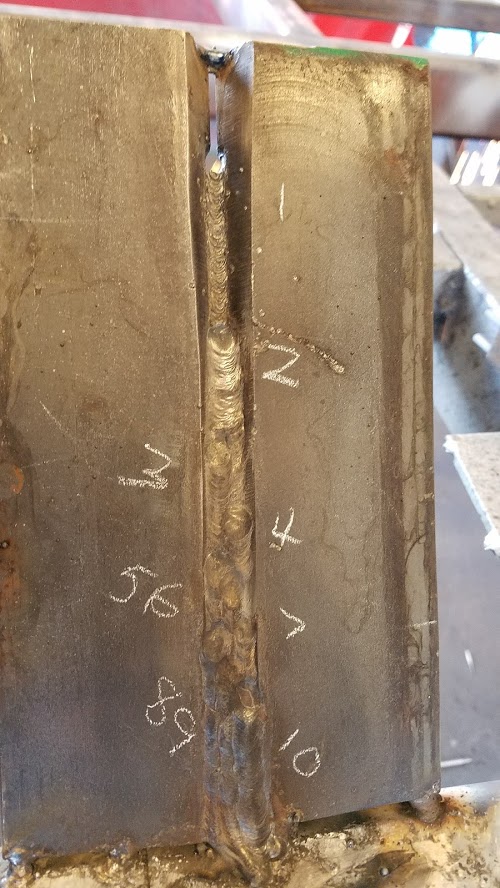
- Prepare the plate: use two A36 steel plates, each 1 inch thick and about 4 by 6 inches, with a 22.5-degree bevel on the 6-inch edges. Tack both pieces to a backing strip that is 1/4 inch thick, 1 inch wide and 8 inches long, with about a 1/4-inch gap between the plates. The 4G overhead plate is built the same way.
- Weld it: with Stick, weave the first two passes and run stringer beads for the rest. Stringers keep the heat down, which is why we teach them.
- Choose your rod: we recommend a low-hydrogen rod, such as 7018, because your certification will be accepted on nearly every job site.
- Plan your time: about two hours per position. An experienced welder can finish a plate in 20 minutes, and the overhead plate takes another hour or two.
Straight answers
What is the difference between certification training and certification testing?
Training teaches you to weld and lets you practice the test. Testing is the test itself, with a Certified Welding Inspector judging your welds. Our programs include both: you train, then use the test attempts included in your tuition. Experienced welders can also test without taking a class: call (702) 824-0457.
Can I take a certification test without taking a class?
Yes. We offer certification testing without a class. Please call (702) 824-0457 and ask for more information. We are open Monday through Friday, 8AM to 6PM.
Do I need welding experience before I start?
No. Most students walk in having never struck an arc. Every program starts with the fundamentals before moving to certification-level work.
How many certification test attempts are included?
Arc Pro includes 4 certification test attempts, Arc Elite Plus includes 2 groove test attempts (an $800 value) and Arc Elite includes 1. Additional tests are available. An attempt is your chance to take the test, and the result depends on your welds.
Which program should I choose if my goal is certification?
Arc Pro (240 hours) trains MIG, TIG, Stick and Flux-Core with 4 test attempts. Arc Elite Plus (60 hours) lets you pick one process and train all six positions, 1F, 2F, 3F, 4F, 3G and 4G, with 2 groove test attempts, which covers the positions behind the 1-inch plate test we recommend. Arc Elite (30 hours) covers 1F, 2F and 3F for an entry-level start with 1 test attempt.
Why do you recommend a 1-inch plate test in the 3G and 4G positions?
Passing both can qualify you to weld structural steel in any position and any thickness with your process, within the ranges used in your test. That gives employers and customers more reasons to hire you than a narrow test such as a fillet weld on thin plate. The exact limits come from the welding code and its edition, such as AWS D1.1.
How long does a certification test take?
An experienced welder can finish a 3G vertical-up plate in about 20 minutes, but plan on about two hours per position. The overhead 4G plate takes another hour or two. Pace matters more than speed, because the bend test only checks the quality of the weld.
What does the Certified Welding Inspector do during the test?
A Certified Welding Inspector (CWI), recognized by the American Welding Society, watches the test, then runs bend tests on your coupons, and other tests where required, to check for cracks and lack of fusion. If your coupon passes, the CWI provides the paperwork with an authorized stamp and signature.
How much does it cost?
Each program page lists its tuition, and test attempts are included. For testing without a class, please call (702) 824-0457 and ask for details and pricing.
More answers are on our FAQs page, and you can read about the family behind the shop on the About page.
Ready to train for your certification test?
